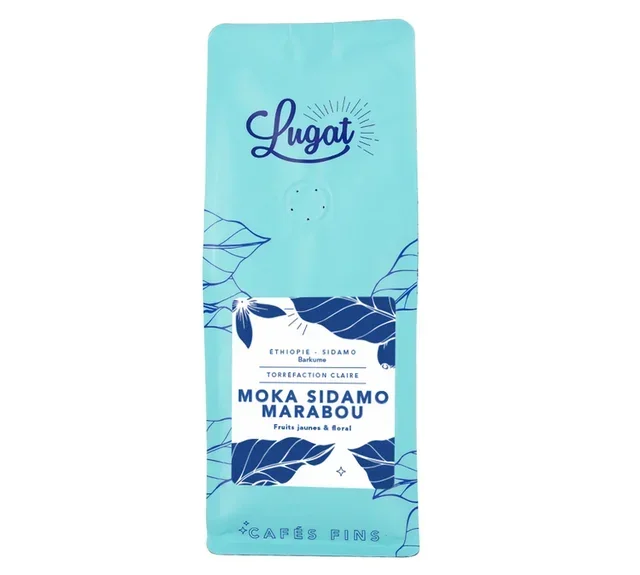
Other production characteristics:
Harvest period: December to March
The story of Lugat:
Lionel Lugat is the emblematic roaster of MaxiCoffee . Over the years, he has managed to surround himself with a solid team of roasters.
By turns coffee expert , judge at the French Coffee Championships and discerning chronicler of our coffee channel , Lionel tells you the story Lugat and his passion for the world of roasting below.
Presentation of the Sidamo region:
The Sidamo region is located in the South of Ethiopia, at the border with Kenya. It owes its name to an ethnic group: the Sidimas , people living in the south-west of Ethiopia. The South of the country constitutes a privileged and exclusive place for coffee growing.
The coffees grow under the shade of forest trees and are picked manually in a selective way. Then, they undergo a wet process, a method which gives it a very beautiful acidity.
The Moka Sidamo represents 11% of production. The washed quality is highly sought after.
For the little story...
Cradle of coffee , Ethiopia cultivates exclusively the botanical species " Arabica" at altitudes between 1500 and 2300 meters above sea level.
The higher the coffee is grown in the high plateaus , the better the organoleptic quality of the roasted bean , especially in terms of liveliness.
Ethiopian coffees are called " Moka Coffees" because they were formerly exported from the Port of Mocha in Yemen, in the Arabian peninsula. There are several types of Moka.
With 400,000 hectares of cultivated areas, coffee still occupies a central place in the economy Ethiopian, particularly regarding currencies.
The country holds 5th place as a producer and 10th position worldwide in terms of exports. 60% of the harvest is destined for export, representing 172,000 tonnes per year.
The coffee trees are cultivated: under natural forest cover (15%), in semi-forest system (35%), in association with other crops (35%) or in intensive cultivation (15%).
80% of coffees are coffees classified as "natural" as they undergo dry process treatment and the remaining 20% are so-called "washed" coffees.
The vast majority of producers do not use chemical inputs. Ethiopian coffee could claim the organic label, but the country has not established certification, probably due to costs being too high.